El Violín del Puente Nuevo
(The Violin of the New Bridge)
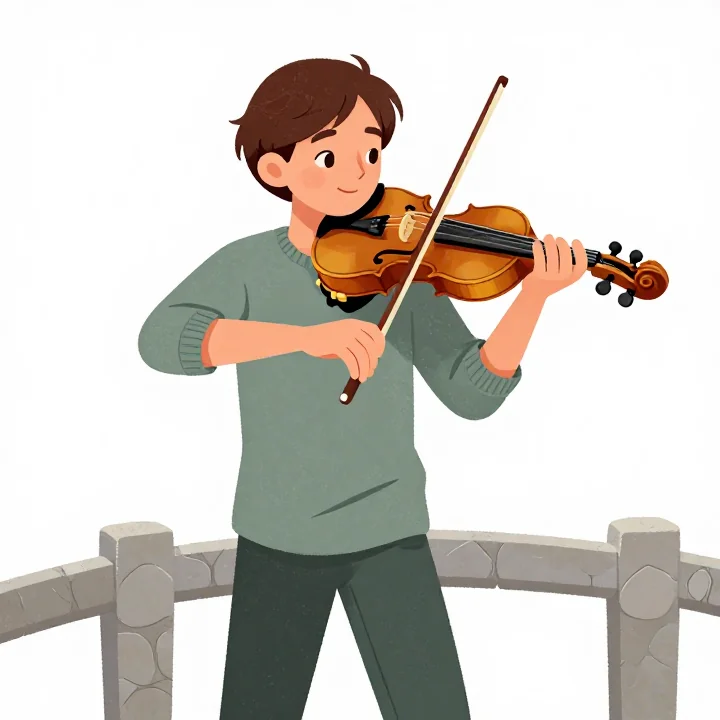
Todas las noches, a las once en punto, alguien tocaba un violín cerca del Puente Nuevo de Ronda.
Every night, at exactly eleven o'clock, someone played a violin near the New Bridge of Ronda.
La música llegaba desde el fondo del desfiladero y subía por las paredes de roca hasta las calles vacías.
The music came from the bottom of the gorge and climbed up the rock walls to the empty streets.
Los vecinos cerraban las ventanas porque decían que aquella melodía traía mala suerte.
The neighbours closed their windows because they said that melody brought bad luck.
Pero a Marcos, un periodista que acababa de mudarse al pueblo, le parecía hermosa.
But to Marcos, a journalist who had just moved to the town, it seemed beautiful.
Una noche, Marcos decidió investigar.
One night, Marcos decided to investigate.
Bajó por el sendero que llevaba al fondo del desfiladero con una linterna en la mano.
He went down the path that led to the bottom of the gorge with a torch in his hand.
El camino era estrecho y resbaladizo.
The path was narrow and slippery.
A medida que descendía, la música sonaba más fuerte y más clara.
As he descended, the music sounded louder and clearer.
Era una pieza triste, como una despedida.
It was a sad piece, like a farewell.
Cuando llegó al fondo, la música se detuvo de golpe.
When he reached the bottom, the music stopped abruptly.
No había nadie.
There was nobody.
Solo encontró un estuche de violín viejo apoyado contra una roca.
He only found an old violin case leaning against a rock.
Estaba cubierto de musgo y parecía llevar allí muchos años.
It was covered in moss and seemed to have been there for many years.
Lo abrió con cuidado.
He opened it carefully.
Dentro no había ningún instrumento, pero sí una fotografía en blanco y negro y una nota escrita a mano.
Inside there was no instrument, but there was a black and white photograph and a handwritten note.
La fotografía mostraba a una mujer joven con un violín, de pie junto al puente.
The photograph showed a young woman with a violin, standing next to the bridge.
En la nota ponía: <<Me llamo Lucía Vega.
The note read: <<My name is Lucia Vega.
Si encuentras esto, busca mi nombre en los archivos del Ayuntamiento.
If you find this, look for my name in the Town Hall archives.
La verdad merece ser contada>>.
The truth deserves to be told>>.
La fecha era de 1962.
The date was from 1962.
Marcos guardó la nota en el bolsillo y subió la cuesta con el corazón acelerado.
Marcos put the note in his pocket and climbed up the hill with his heart racing.
Al día siguiente, fue al Ayuntamiento y pidió acceso a los archivos históricos.
The next day, he went to the Town Hall and requested access to the historical archives.
Una funcionaria amable le ayudó a buscar.
A kind civil servant helped him search.
Después de dos horas entre documentos amarillentos, encontraron un expediente con el nombre de Lucía Vega.
After two hours among yellowed documents, they found a file with the name Lucia Vega.
Según los papeles, había sido una violinista brillante que desapareció en 1962 sin dejar rastro.
According to the papers, she had been a brilliant violinist who disappeared in 1962 without a trace.
La policía cerró el caso sin resolverlo.
The police closed the case without solving it.
Marcos publicó un artículo sobre Lucía en el periódico local.
Marcos published an article about Lucia in the local newspaper.
Una semana después, una anciana llamó a la redacción.
A week later, an elderly woman called the newsroom.
Dijo que era la hermana de Lucía y que llevaba décadas esperando que alguien contara su historia. <<Mi hermana no desapareció>>, explicó con voz temblorosa. <<Se fue a Francia para tocar en una orquesta, pero nuestra familia no quiso que nadie lo supiera.
She said she was Lucia's sister and that she had been waiting for decades for someone to tell her story. <<My sister did not disappear>>, she explained in a trembling voice. <<She went to France to play in an orchestra, but our family did not want anyone to know.
En aquella época, las mujeres no debían marcharse solas>>.
In those times, women were not supposed to leave on their own>>.
Esa noche, Marcos volvió al desfiladero.
That night, Marcos returned to the gorge.
El estuche ya no estaba.
The case was no longer there.
En su lugar había una rosa blanca sobre la roca.
In its place there was a white rose on the rock.
Y por primera vez en mucho tiempo, el pueblo de Ronda durmió en silencio.
And for the first time in a long while, the town of Ronda slept in silence.
El violín no volvió a sonar jamás.
The violin never played again.
Key Vocabulary
el desfiladero the gorge, the ravine
el sendero the path, the trail
resbaladizo slippery
el estuche the case (for an instrument)
el musgo the moss
el expediente the file, the record
el rastro the trace, the trail
la redacción the newsroom, the editorial office
la anciana the elderly woman
marcharse to leave, to go away