El Sobre de la Librería
(The Bookshop Envelope)
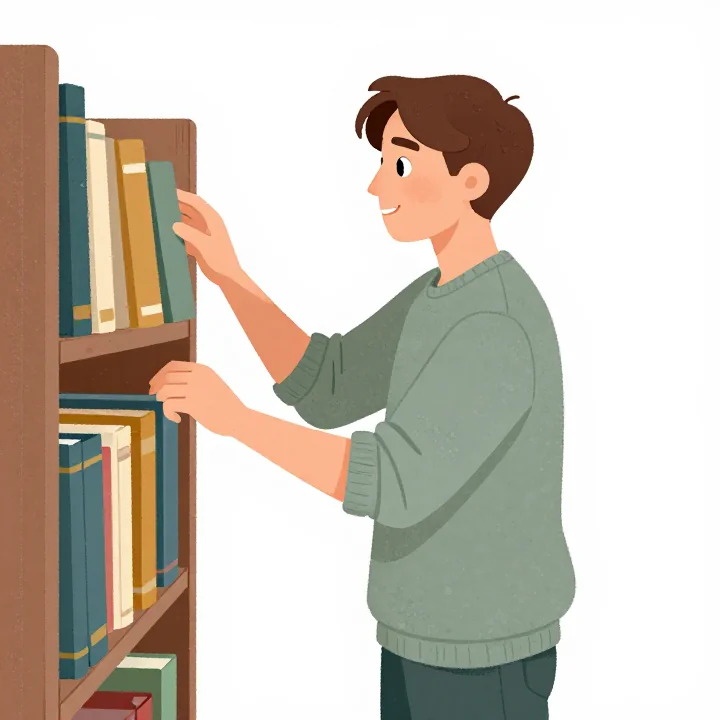
Pablo trabajaba en una librería de segunda mano en el centro de Granada.
Pablo worked in a second-hand bookshop in the centre of Granada.
Todas las mañanas, antes de abrir la tienda, revisaba las cajas de libros que llegaban de casas antiguas.
Every morning, before opening the shop, he checked the boxes of books that arrived from old houses.
Un martes de octubre, mientras vaciaba una caja de novelas viejas, encontró un sobre amarillento escondido entre las páginas de un libro de poesía.
One Tuesday in October, while he was emptying a box of old novels, he found a yellowish envelope hidden between the pages of a poetry book.
La carta estaba escrita a mano con tinta azul.
The letter was handwritten in blue ink.
Una mujer llamada Lucía le escribía a alguien sobre las tardes que habían pasado juntos en la Alhambra.
A woman called Lucía was writing to someone about the afternoons they had spent together at the Alhambra.
Hablaba de un beso bajo los arcos del Generalife y de una promesa que nunca se había cumplido.
She spoke of a kiss under the arches of the Generalife and of a promise that had never been kept.
La carta no tenía fecha ni dirección.
The letter had no date or address.
Sin embargo, cada palabra transmitía una emoción tan profunda que Pablo la leyó tres veces.
However, every word conveyed such a deep emotion that Pablo read it three times.
A lo largo de las semanas siguientes, Pablo no pudo dejar de pensar en aquella carta.
Over the following weeks, Pablo could not stop thinking about that letter.
Se preguntaba quién era Lucía y si la persona a la que escribía había llegado a leerla alguna vez.
He wondered who Lucía was and whether the person she was writing to had ever read it.
Es posible que la carta se hubiera perdido antes de llegar a su destino.
It is possible that the letter had been lost before reaching its destination.
De todas formas, decidió que tenía que intentar encontrar a la autora.
In any case, he decided that he had to try to find the author.
Buscó el nombre de Lucía en las guías telefónicas antiguas de Granada.
He searched for Lucía's name in the old telephone directories of Granada.
Después de muchas llamadas, localizó a una mujer de ochenta y dos años que vivía cerca del Albaicín.
After many calls, he found an eighty-two-year-old woman who lived near the Albaicín.
Cuando Pablo fue a visitarla y le mostró la carta, los ojos de Lucía se llenaron de lágrimas. <<Escribí esa carta hace más de cincuenta años>>, dijo con voz temblorosa. <<Era para un hombre que se marchó a Argentina sin despedirse.
When Pablo went to visit her and showed her the letter, Lucía's eyes filled with tears. <<I wrote that letter more than fifty years ago>>, she said in a trembling voice. <<It was for a man who left for Argentina without saying goodbye.
Ojalá la hubiera enviado>>.
I wish I had sent it>>.
Pablo se quedó con ella toda la tarde, escuchando historias de un amor que el tiempo no había borrado.
Pablo stayed with her all afternoon, listening to stories of a love that time had not erased.
Al despedirse, Lucía le dijo: <<Nunca dejes para mañana las palabras que sientes hoy>>.
When saying goodbye, Lucía said to him: <<Never leave for tomorrow the words you feel today>>.
Aquella noche, Pablo volvió a casa pensando en alguien a quien hacía meses que no llamaba.
That night, Pablo went home thinking about someone he had not called for months.
Sacó el teléfono y, por primera vez en mucho tiempo, marcó su número.
He took out his phone and, for the first time in a long time, dialled their number.
Key Vocabulary
de segunda mano second-hand
a lo largo de over, throughout (a period of time)
dejar de + infinitive to stop doing something
cumplir(se) to fulfil, to keep (a promise)
ojalá + subjuntivo I wish / if only (+ subjunctive)
despedirse to say goodbye (reflexive)
marcharse to leave, to go away (reflexive)
de todas formas in any case, anyway