La Clave del Organista
(The Organist's Code)
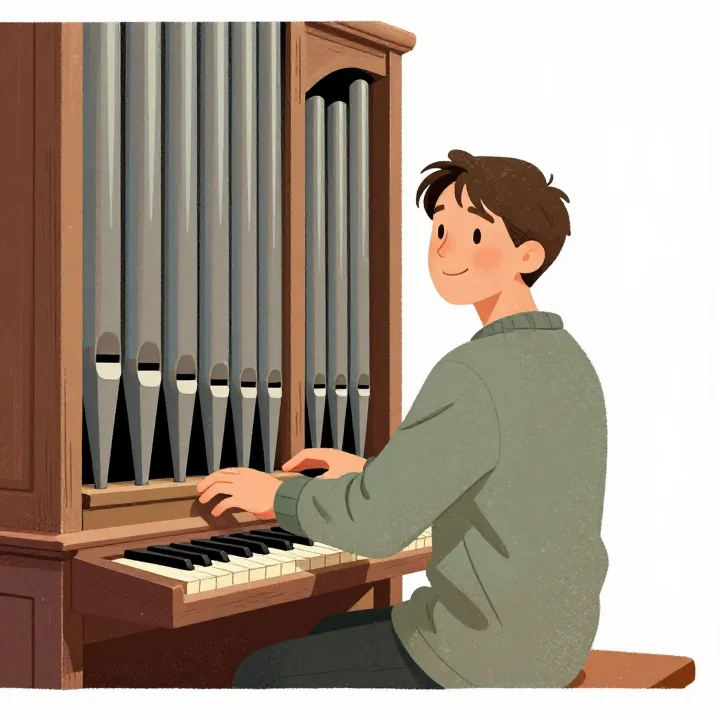
Cuando el organista de la catedral de Burgos murió a los noventa y tres años, dejó un testamento que desconcertó a todos.
When the organist of the cathedral of Burgos died at the age of ninety-three, he left a will that bewildered everyone.
En lugar de repartir sus posesiones entre sus sobrinos, don Ildefonso había dejado una única instrucción: <<La persona que descifre la melodía que toqué en mi último concierto heredará todo lo que poseo>>.
Instead of distributing his possessions among his nieces and nephews, don Ildefonso had left a single instruction: <<The person who deciphers the melody I played at my last concert will inherit everything I own>>.
Sus sobrinos, que habían esperado recibir su colección de arte y su casa en el centro de Burgos, se quedaron atónitos.
His nieces and nephews, who had expected to receive his art collection and his house in central Burgos, were left astonished.
La notaria encargada del caso, doña Carmen, intentó localizar una grabación del último concierto, pero no existía ninguna.
The notary in charge of the case, doña Carmen, tried to locate a recording of the last concert, but none existed.
Don Ildefonso había tocado a puerta cerrada, sin público, la noche antes de morir.
Don Ildefonso had played behind closed doors, without an audience, the night before he died.
La catedral confirmó que había estado allí solo durante dos horas, pero nadie sabía qué había interpretado.
The cathedral confirmed he had been there alone for two hours, but nobody knew what he had performed.
Los sobrinos contrataron a musicólogos y organistas profesionales, pero sin la grabación era imposible saber qué melodía había tocado.
The nieces and nephews hired musicologists and professional organists, but without the recording it was impossible to know which melody he had played.
Seis meses después, una joven llamada Nerea visitó la catedral como turista.
Six months later, a young woman called Nerea visited the cathedral as a tourist.
Era estudiante de música y pidió permiso para tocar el órgano.
She was a music student and asked permission to play the organ.
Mientras exploraba los registros del instrumento, notó algo extraño: uno de los tiradores tenía un papel enrollado dentro.
While she explored the instrument's stops, she noticed something strange: one of the knobs had a rolled-up piece of paper inside.
Lo sacó con cuidado y encontró una partitura manuscrita con el título <<Para quien tenga la paciencia de buscar>>.
She pulled it out carefully and found a handwritten score with the title <<For whoever has the patience to search>>.
Debajo, una nota añadía: <<La herencia no es para quien la merezca, sino para quien sienta curiosidad por el mundo>>.
Below, a note added: <<The inheritance is not for whoever deserves it, but for whoever feels curiosity about the world>>.
Nerea presentó la partitura a la notaria.
Nerea presented the score to the notary.
Los musicólogos confirmaron que era la letra de don Ildefonso y que la melodía coincidía con las notas que los sensores de presión del órgano habían registrado aquella noche.
The musicologists confirmed it was don Ildefonso's handwriting and that the melody matched the notes the organ's pressure sensors had recorded that night.
La herencia fue a parar a una estudiante que no había oído hablar de don Ildefonso hasta aquel día.
The inheritance went to a student who had not heard of don Ildefonso until that day.
Los sobrinos protestaron, pero el testamento era claro.
The nieces and nephews protested, but the will was clear.
Don Ildefonso había decidido que su legado lo merecía alguien que se atreviera a explorar lo que otros pasaban por alto.
Don Ildefonso had decided that his legacy was deserved by someone who dared to explore what others overlooked.
Key Vocabulary
el organista the organist
el testamento the will, the testament
descifrar to decipher
la partitura the score (music)
la notaria the notary
el registro the stop (organ), the register
el legado the legacy
atreverse a to dare to
pasar por alto to overlook
desconcertar to bewilder, to disconcert