El Mapa de los Abuelos
(The Grandparents' Map)
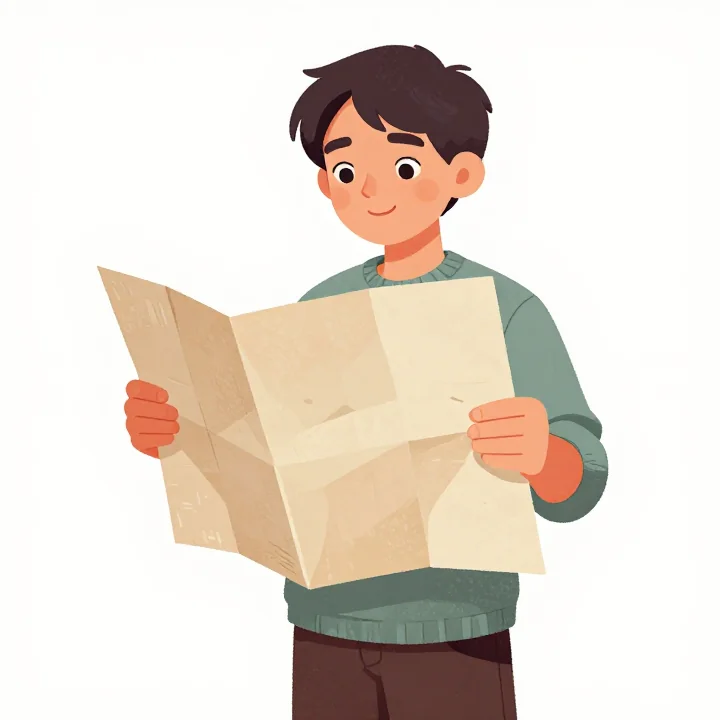
Clara encontró el mapa doblado dentro de una Biblia que nadie había abierto en treinta años.
Clara found the map folded inside a Bible that nobody had opened in thirty years.
Estaba dibujado a mano sobre papel amarillento, con una ruta que iba desde Sevilla hasta Santiago de Compostela.
It was drawn by hand on yellowed paper, with a route that went from Seville to Santiago de Compostela.
En los márgenes, su abuela había escrito nombres de pueblos, fondas y platos que habían probado.
In the margins, her grandmother had written names of villages, inns and dishes they had tried.
Era el mapa de su luna de miel, en 1962.
It was the map of their honeymoon, in 1962.
Decidió seguir la misma ruta.
She decided to follow the same route.
Pidió dos semanas de vacaciones en el trabajo, alquiló un coche pequeño y salió de Sevilla un martes de abril, con el mapa de sus abuelos en el asiento del copiloto.
She asked for two weeks of holiday at work, rented a small car and left Seville on a Tuesday in April, with her grandparents' map on the passenger seat.
No usó el GPS.
She did not use GPS.
Quería perderse de la misma manera que ellos se habían perdido.
She wanted to get lost in the same way that they had got lost.
En Córdoba, la fonda que aparecía en el mapa era ahora un hotel boutique con wifi y yoga por las mañanas.
In Cordoba, the inn that appeared on the map was now a boutique hotel with wifi and morning yoga.
En un pueblo de La Mancha, el restaurante donde sus abuelos habían comido migas manchegas se había convertido en una gasolinera.
In a village in La Mancha, the restaurant where her grandparents had eaten migas manchegas had become a petrol station.
Clara sintió algo parecido a la decepción, pero siguió conduciendo.
Clara felt something similar to disappointment, but she kept driving.
Fue en un pueblo de León donde todo cambió.
It was in a village in Leon where everything changed.
El mapa indicaba una panadería junto a una fuente de piedra.
The map indicated a bakery next to a stone fountain.
Clara aparcó y caminó por una calle estrecha.
Clara parked and walked along a narrow street.
Allí estaba la fuente, exactamente igual.
There was the fountain, exactly the same.
Y al lado, la panadería, con el mismo nombre pintado a mano sobre la puerta.
And next to it, the bakery, with the same name painted by hand above the door.
Dentro, una mujer mayor amasaba pan como si el tiempo no existiera.
Inside, an elderly woman was kneading bread as if time did not exist.
Mi madre también hacía pan aquí, dijo la mujer cuando Clara le preguntó.
My mother also made bread here, said the woman when Clara asked her.
Y mi abuela antes que ella.
And my grandmother before her.
Clara le enseñó el mapa.
Clara showed her the map.
La mujer lo miró con los ojos muy abiertos.
The woman looked at it with her eyes wide open.
Sí, me acuerdo de una pareja joven.
Yes, I remember a young couple.
Ella llevaba un pañuelo rojo.
She was wearing a red scarf.
Compraron una hogaza entera y se sentaron junto a la fuente.
They bought a whole loaf and sat down next to the fountain.
Clara compró pan en esa misma panadería y se sentó junto a la misma fuente.
Clara bought bread at that same bakery and sat down next to the same fountain.
Comió despacio, mirando el mapa, y pensó que quizás viajar no consistía en encontrar lo que había cambiado, sino en reconocer lo que se había negado a desaparecer.
She ate slowly, looking at the map, and thought that perhaps travelling was not about finding what had changed, but about recognising what had refused to disappear.
Dobló el mapa con cuidado, como si fuera una carta de amor, y lo dejó en el asiento del copiloto para el siguiente pueblo.
She folded the map carefully, as if it were a love letter, and left it on the passenger seat for the next village.
Key Vocabulary
la luna de miel honeymoon
la fonda inn, boarding house
amarillento yellowish, yellowed
amasar to knead
la hogaza a round loaf of bread
negarse a to refuse to
el copiloto co-pilot, passenger seat