Los Relojes de Marte
(The Clocks of Mars)
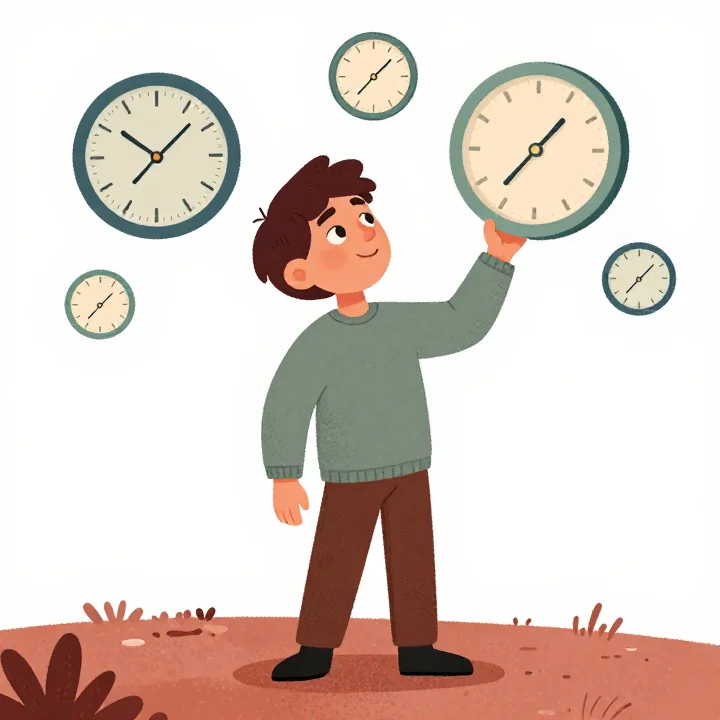
La doctora Paloma Estrada había sido seleccionada para la primera misión tripulada a Marte.
Doctor Paloma Estrada had been selected for the first crewed mission to Mars.
Aunque aquello era considerado el mayor logro de su carrera, no podía evitar sentir que algo fundamental se le escapaba.
Although this was considered the greatest achievement of her career, she could not help feeling that something fundamental was slipping away from her.
Desde el centro de control en Sevilla, le habían comunicado que la nave sería lanzada en marzo, lo cual significaba que le quedaban apenas tres meses para despedirse de todo lo que conocía.
From the control centre in Seville, they had informed her that the ship would be launched in March, which meant she had barely three months left to say goodbye to everything she knew.
No obstante, lo que más la perturbaba no era la distancia ni el peligro, sino una pregunta que nadie había sabido responderle: si el tiempo se mide de forma distinta en otro planeta, ¿seguiría siendo la misma persona al llegar?
Nevertheless, what disturbed her most was not the distance or the danger, but a question that nobody had been able to answer for her: if time is measured differently on another planet, would she still be the same person upon arriving?
Su colega, el ingeniero Rafael Montero, le dijo que dejara de preocuparse. <<Si hubieras estudiado ingeniería en lugar de astrofísica, no te harías esas preguntas absurdas>>, bromeó.
Her colleague, the engineer Rafael Montero, told her to stop worrying. <<If you had studied engineering instead of astrophysics, you would not ask yourself those absurd questions,>> he joked.
Sin embargo, Paloma sabía que Rafael también sentía inquietud, aunque jamás lo hubiera admitido en voz alta.
However, Paloma knew that Rafael also felt unease, although he would never have admitted it aloud.
La noche antes del lanzamiento, Paloma se sentó en la azotea de su apartamento y contempló las estrellas.
The night before the launch, Paloma sat on the rooftop of her apartment and gazed at the stars.
Recordó que su abuela le había contado que los antiguos navegantes españoles medían el tiempo según las mareas, y que cuando cruzaban el océano, sus relojes dejaban de tener sentido.
She remembered that her grandmother had told her that the ancient Spanish navigators measured time by the tides, and that when they crossed the ocean, their clocks stopped making sense.
Le habría gustado preguntarle qué se sentía al abandonar la única medida del tiempo que uno conoce, pero su abuela había fallecido años atrás.
She would have liked to ask her what it felt like to abandon the only measure of time one knows, but her grandmother had passed away years before.
El viaje duró siete meses.
The journey lasted seven months.
Paloma llevó un diario en el que anotaba no solo los datos científicos que le eran requeridos, sino también sus sueños, que se volvieron cada vez más extraños a medida que se alejaban de la Tierra.
Paloma kept a diary in which she recorded not only the scientific data that was required of her, but also her dreams, which became increasingly strange as they moved further from Earth.
Soñaba con relojes que se derretían como los de Dalí y con voces que le susurraban fechas que no existían.
She dreamed of clocks that melted like Dali's and of voices that whispered dates that did not exist to her.
Rafael le comentó que probablemente aquello se debiera a la falta de gravedad, pero Paloma sospechaba que era algo más profundo.
Rafael told her it was probably due to the lack of gravity, but Paloma suspected it was something deeper.
Cuando por fin aterrizaron en la llanura de Elíseo, Paloma comprobó que un día marciano duraba treinta y siete minutos más que uno terrestre.
When they finally landed on the Elysium plain, Paloma verified that a Martian day lasted thirty-seven minutes more than an Earth one.
Aquellos minutos adicionales se acumulaban como arena en un reloj invertido.
Those extra minutes accumulated like sand in an inverted hourglass.
Se le fue informado de que el equipo debía ajustar sus ciclos de sueño, pero el cuerpo de Paloma se resistía, como si su biología se negara a aceptar que el tiempo pudiera estirarse.
She was informed that the team had to adjust their sleep cycles, but Paloma's body resisted, as if her biology refused to accept that time could stretch.
Una mañana marciana, mientras recogía muestras de roca, encontró algo que la dejó sin aliento.
One Martian morning, while collecting rock samples, she found something that left her breathless.
Medio enterrado en el polvo rojizo había un objeto metálico con engranajes diminutos.
Half-buried in the reddish dust there was a metallic object with tiny gears.
Parecía un reloj.
It looked like a clock.
Se dijo a sí misma que debía de tratarse de un fragmento de alguna sonda anterior, pero cuando lo limpió con cuidado, descubrió que las manecillas se movían.
She told herself that it must be a fragment from some previous probe, but when she cleaned it carefully, she discovered that the hands were moving.
No marcaban horas terrestres, sino un ritmo que latía con la misma cadencia que la rotación del planeta.
They did not mark terrestrial hours, but a rhythm that pulsed with the same cadence as the rotation of the planet.
Paloma sostuvo el reloj contra su pecho y cerró los ojos.
Paloma held the clock against her chest and closed her eyes.
Comprendió que la respuesta a su pregunta había estado esperándola a doscientos veinticinco millones de kilómetros de casa.
She understood that the answer to her question had been waiting for her two hundred and twenty-five million kilometres from home.
No era que el tiempo fuese diferente en Marte; era que siempre había existido más de una manera de medirlo.
It was not that time was different on Mars; it was that there had always existed more than one way to measure it.
Y quizás, pensó mientras las manecillas giraban al compás de un mundo que apenas empezaban a conocer, eso era exactamente lo que significaba ser humano: la capacidad de reinventar el ritmo de la propia existencia cada vez que se cruza un nuevo umbral.
And perhaps, she thought as the hands turned to the rhythm of a world they were only beginning to know, that was exactly what it meant to be human: the capacity to reinvent the rhythm of one's own existence every time one crosses a new threshold.
Key Vocabulary
tripulado crewed, manned
la azotea the rooftop, the terrace
la marea the tide
el engranaje the gear, the cog
la manecilla the clock hand
la cadencia the cadence, the rhythm
el umbral the threshold
derretirse to melt
la sonda the probe (spacecraft)
estirarse to stretch