El Cuaderno de las Voces
(The Notebook of Voices)
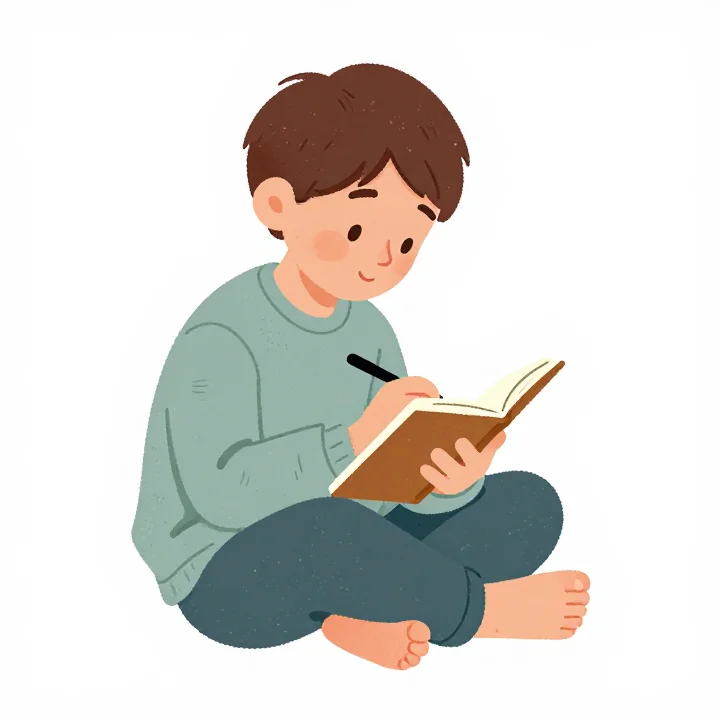
Marta Revilla encontró el cuaderno en la casa de su abuela, tres días después del funeral.
Marta Revilla found the notebook in her grandmother's house, three days after the funeral.
Estaba escondido en el fondo de un armario, envuelto en un paño de seda negra, como si alguien hubiera querido protegerlo o, quizá, proteger a los demás de él.
It was hidden at the back of a wardrobe, wrapped in a black silk cloth, as if someone had wanted to protect it or, perhaps, to protect others from it.
Las páginas amarillentas estaban cubiertas de una letra diminuta que Marta reconoció al instante: era la caligrafía de su abuela, Soledad.
The yellowed pages were covered in tiny handwriting that Marta recognised instantly: it was her grandmother Soledad's handwriting.
El cuaderno contenía cientos de frases sueltas, cada una precedida por una fecha y una hora exactas.
The notebook contained hundreds of loose sentences, each one preceded by an exact date and time.
Parecían transcripciones de algo que Soledad hubiera escuchado, aunque muchas de ellas carecían de sentido: fragmentos de conversaciones ajenas, advertencias incomprensibles, nombres de personas que Marta no conocía.
They looked like transcriptions of something Soledad had heard, although many of them made no sense: fragments of other people's conversations, incomprehensible warnings, names of people Marta did not know.
Una entrada, fechada quince años atrás, decía: <<No abras la ventana esta noche.
One entry, dated fifteen years earlier, said: <<Do not open the window tonight.
Él viene con el viento.>> Otra, más reciente: <<La niña del tercero sabe lo que le va a pasar, pero no puede decirlo.>>
He comes with the wind.>> Another, more recent: <<The girl on the third floor knows what is going to happen to her, but she cannot say it.>>
Marta le preguntó a su madre si la abuela había sufrido algún tipo de demencia.
Marta asked her mother whether her grandmother had suffered from some kind of dementia.
Su madre, Pilar, negó con la cabeza lentamente. <<Tu abuela no estaba loca>>, dijo. <<Oía cosas.
Her mother, Pilar, shook her head slowly. <<Your grandmother was not mad,>> she said. <<She heard things.
Siempre las oyó.
She always heard them.
Decía que eran las voces de personas que todavía no sabían que iban a necesitar ayuda.
She said they were the voices of people who did not yet know they were going to need help.
Al principio yo creía que se lo inventaba, pero hubo cosas que se cumplieron.
At first I thought she was making it up, but there were things that came true.
Cosas que habría sido imposible que ella supiera de antemano.>>
Things it would have been impossible for her to have known beforehand.>>
Aquella noche, Marta se llevó el cuaderno a su piso.
That night, Marta took the notebook to her flat.
Lo dejó sobre la mesilla y se acostó sin encender la luz, pensando en su abuela, en aquella mujer silenciosa que siempre parecía estar escuchando algo que los demás no podían percibir.
She left it on the bedside table and went to bed without turning on the light, thinking about her grandmother, about that quiet woman who had always seemed to be listening to something the others could not perceive.
A las tres de la madrugada, Marta se despertó de golpe.
At three in the morning, Marta woke with a start.
El cuaderno estaba abierto.
The notebook was open.
Habría jurado que lo había dejado cerrado.
She could have sworn she had left it closed.
En la última página escrita, con la misma letra de Soledad, había una frase que Marta no había visto antes: <<Cuando la nieta lea esto, ya habrá empezado a oírlas también.>>
On the last written page, in Soledad's same handwriting, there was a sentence Marta had not seen before: <<When the granddaughter reads this, she will already have begun to hear them too.>>
Marta cerró el cuaderno de un golpe y se quedó inmóvil, conteniendo la respiración.
Marta shut the notebook with a snap and stayed motionless, holding her breath.
La habitación estaba en silencio.
The room was in silence.
Pero entonces, tan débil que casi podría haber sido imaginado, llegó un susurro.
But then, so faint it could almost have been imagined, a whisper arrived.
No venía de fuera ni de los vecinos.
It did not come from outside or from the neighbours.
Parecía brotar del aire mismo, como si la oscuridad tuviera boca.
It seemed to spring from the air itself, as if the darkness had a mouth.
Decía algo en un idioma que Marta no reconocía, pero cuyo significado, de alguna manera inexplicable, comprendió con absoluta claridad: era una advertencia.
It said something in a language Marta did not recognise, but whose meaning, in some inexplicable way, she understood with absolute clarity: it was a warning.
Se quedó sentada en la cama hasta que amaneció, sin atreverse a abrir de nuevo el cuaderno, sin atreverse a cerrar los ojos.
She sat on the bed until dawn broke, not daring to open the notebook again, not daring to close her eyes.
Porque lo peor no era el susurro en sí, ni el mensaje imposible de su abuela muerta.
Because the worst thing was not the whisper itself, nor the impossible message from her dead grandmother.
Lo peor era que la voz que había escuchado, aquella voz que surgía de la nada, era la suya propia.
The worst thing was that the voice she had heard, that voice which rose from nothingness, was her own.
Y lo que decía, con una urgencia que le helaba la sangre, era su propio nombre.
And what it said, with an urgency that froze her blood, was her own name.
Key Vocabulary
el cuaderno notebook
la caligrafía handwriting, calligraphy
la advertencia warning
el susurro whisper
carecer de to lack
brotar to spring, to sprout
atreverse to dare
la madrugada early morning, small hours
de antemano beforehand, in advance
helar to freeze